
Sources:
History of Mirador 1890-1964
by Fr. Francis X. Clark, S.J.
1876
Manuel Scheidnagel, Governor Politico-Militar of Benguet, describes in a pamphlet the hills of Baguio and mentions El Mirador, "to which, "he says, "I applied the name because of its form and special position in the hills of Baguio." The South China Sea, Lingayen Gulf, and the Ilocos coast are visible fom Mirador.
1890
Fr. Miguel Roses, Rector of the Ateneo de Manila, suggests acquiring a house 1500 meters above sea level in the Province of Benguet to serve as a sanatorium for sick Jesuits.
1894
The request to purchase at El Mirador was made, but due to historical circumstances, the land was not acquired immediately.
1900
Because of its unique elevation, the Manila Observatory established a meteoroligcal and seismic station at Mirador. In time the observatory was advertised as a showplace for tourists and visitors to Baguio.
1906
Under the jurisdiction of the American Philippine Commission, the Jesuits purchased the land on public auction for 1,092.94 pesos for 327,881 square meters.
1907
The Jesuits build a small three-room house of pine boards and cogon roof on the same level as Naguilian Road. Several Jesuit Fathers spend their vacation there between March 18 and June 5. They also begin administering the sacraments in Baguio and Trinidad.
1908
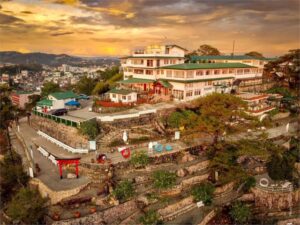
The Jesuits build the road to the summit of the hill and a permanent summer house of stone and mortar
1913
Construction begins for the shrine to Our Lady of Lourdes. The statue is carved by Isabel Tampingco, the same sculptor who worked on the San Ignacio in Intramuros. The statue, which is still in the shrine, is signed and dated.
1918
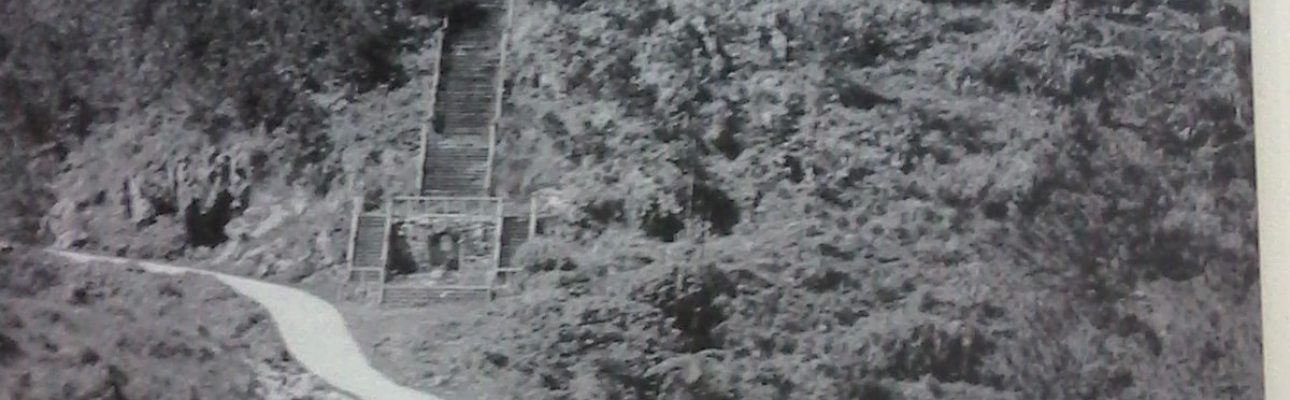
Construction begins for long stairway of 212 steps down the front of the hill.
1941-1944
The Jesuits could not use Mirador during World War II. The Japanese occupy it for military purposes.
1945
The house is completely destroyed when the Americans and Filipinos attack the Japanese. After the war, the Manila Observatory which had also been destroyed in Manila decided to establish the Observatory at Mirador.
1952
Jesuit superiors led by Fr. Leo Cullum decided to rebuild the villa house there as well. Architect Gines River, MIT graduate and designer of the Ateneo de Manila, is asked to design the buildings, noting the public natire of the Observatory, the Jesuits' need for privacy, and the need for a place to walk without going up and down the hill."
The only level spot at the summit is kept free from buildings. Around this oval is a wide walking area. Inside the oval, where the labyrinth is now situated, there was a volleyball court for use of the Jesuits during villa. The Observatory was situated at the western end of the buildings, in what is now known as Wing-C. The entrance to the buildings was also at that end, so that visitors of the Observatory could only go as far as the Chapel and dining room without bothering the Jesuit community."
As the new buildings neared completion, the Jesuits in China are looking for a place to transfer their theologate in Shanghai after the new Communist government closes down all religious institutions. A place is needed for about sixty Jesuits, and the Philippine Jesuits generously allow them to use Mirador.
1952-1967
The Chinese theologate occupied Mirador. During those years, dozens of Jesuits in the China mission are ordained at the Baguio Cathedral
1952-1962
The Observatory operates in Baguio until 1962, when it decides to join the Ateneo de Manila University in its new Loyola Heights campus. The wing occupied by the Observatory at Mirador becomes part of the Jesuit house, but the Observatory continues to maintain a solar, seismic, and magnetic observation station at Mirador. After the departure of the Chinese theologate, the house becomes a villa house for Jesuits and a retreat or seminar house for others.
1962
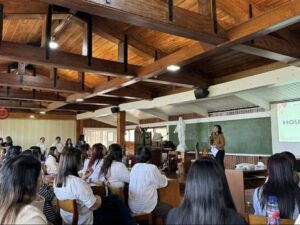
Mirador has served as a retreat house or meeting center for church groups. The Catholic Bishops' Conference of the Philippines used to hold one of its two annual meetings in Mirador. Aside from the annual retreats of the Jesuits, the Jesuits have gathered at Mirador for Province Congregations, and workshops on prayer and the Spiritual Exercises. Faculty, staff, and students of Jesuit schools find Mirador an inviting place for prayer. Many have discovered its charms and beauty.
The Lourdes shrine, build by Fr. Jose Algue, S.J. as a personal project, has metamorphosed into a must-visit toursit spot in Baguio. A truly spiritual lodestone, it attracts hundreds of visitors especially on weekends and during the Holy Week.
Except for the time of the Chinese theologate, no Jesuit community has resided in Baguio. The Jesuit in charge of the house would only make occasional visits.